One end of a horizontal track of gauge λ and negligible resistance, is connected to a capacitor of capacitance C charged to voltage V 0 . The inductance of the assembly is negligible. The system is placed in a homogeneous, vertical magnetic field of induction B, as shown in the figure.
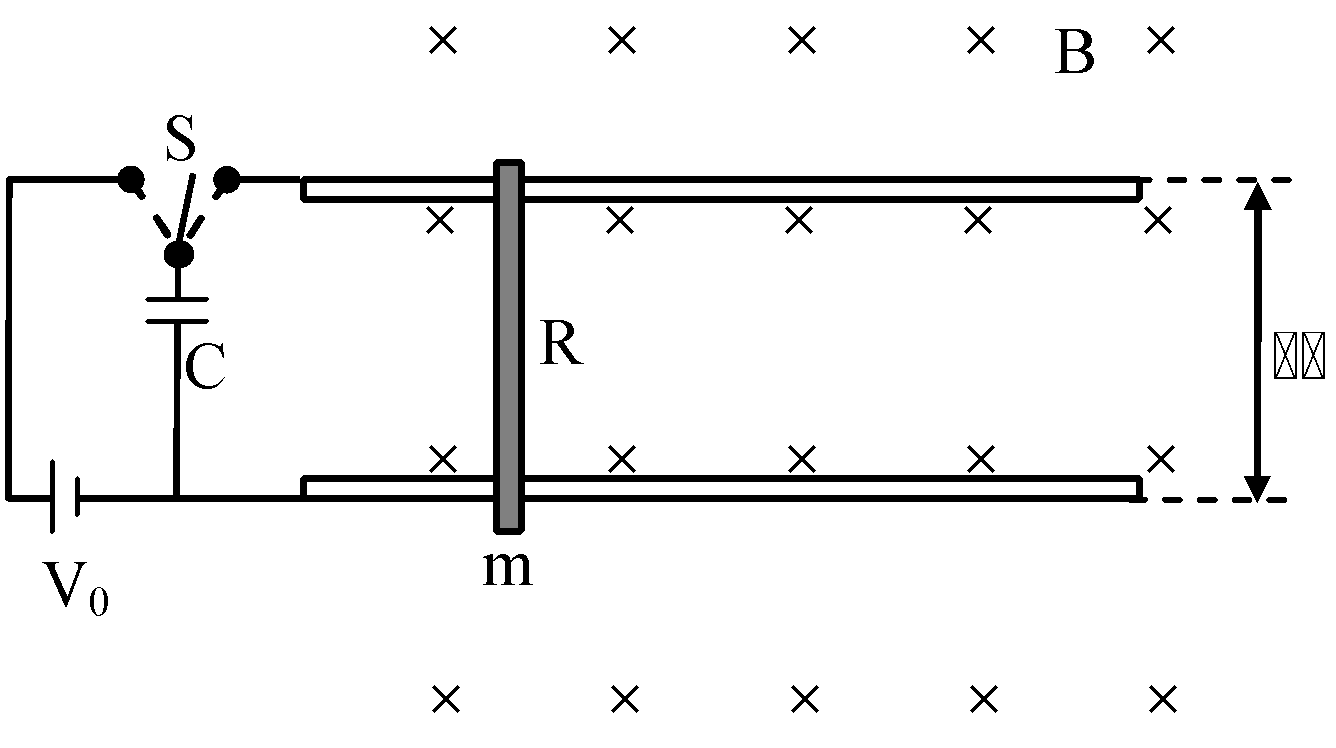
A frictionless conducting rod of mass m and resistance R is placed perpendicularly onto the track. The polarity of the capacitor is such that the rod is repelled from the capacitor when the switch is turned over.
(i) What is the maximum velocity of the rod?
(ii) Under what conditions is the efficiency of this 'electromagnetic gun' maximal?
Text Solution
Verified by ExpertsCHECK THE SOLUTION.
Sol. (i) At the instant when the capacitor is connected, a current I = V 0 /R starts flowing in the rod, which experiences a force F = B λ I and an initial acceleration a = B λ V 0 /mR. In accordance with Lenz's law, the voltage induced in the moving rod causes the current flowing in the rod to decrease. The charge Q on the capacitor decreases and consequently so does the voltage across it. Meanwhile the voltage induced in the rod increases, until the two voltages cancel out each other. The rod then continues with its maximum velocity given by
B λ v max =  …..(1)
The equation of motion of the rod is
m  = ma = B λ I = –
  , …..(2)
where the acceleration and the current have been expressed as the rates of change in velocity and charge, respectively. The proportionality between the two rates of change holds throughout. The speed of the rod increases from zero to v max , whilst the charge on capacitor decreases from Q 0 = CV 0 to Q min . Equation (2) can therefore be rewritten as
mv max = B λ (Q 0 – Q min ).
The final velocity and the residual charge on the capacitor can be calculated using equations (1) and (2),
v max =  and Q min =
  .
.
(ii) The above relations show that the maximum velocity of the rod is proportional to the initial voltage V 0 across the capacitor. Thus, the final kinetic energy of the rod is proportional to V 0 2 (for given values of C and m), i.e. proportional to the initial energy of the system. The coefficient of proportionality can be regarded as
the efficiency η of the apparatus (considered as an electromagnetic gun), and can be written in the form
η 
The product of the two terms in the brackets is 1, and from the inequality between arithmetic and geometric means, it follows that their sum is at least 2. This means that the efficiency of the electromagnetic gun cannot be more than 25 per cent.
Prepare Smarter with CGP Edu
Get practice questions, solutions, and test series in one place.
Write a Review
Share your experience with this question and solution.
Commentary
Send your comment, doubt, correction, or feedback to admin.
Similar Questions
Explore conceptually related problems